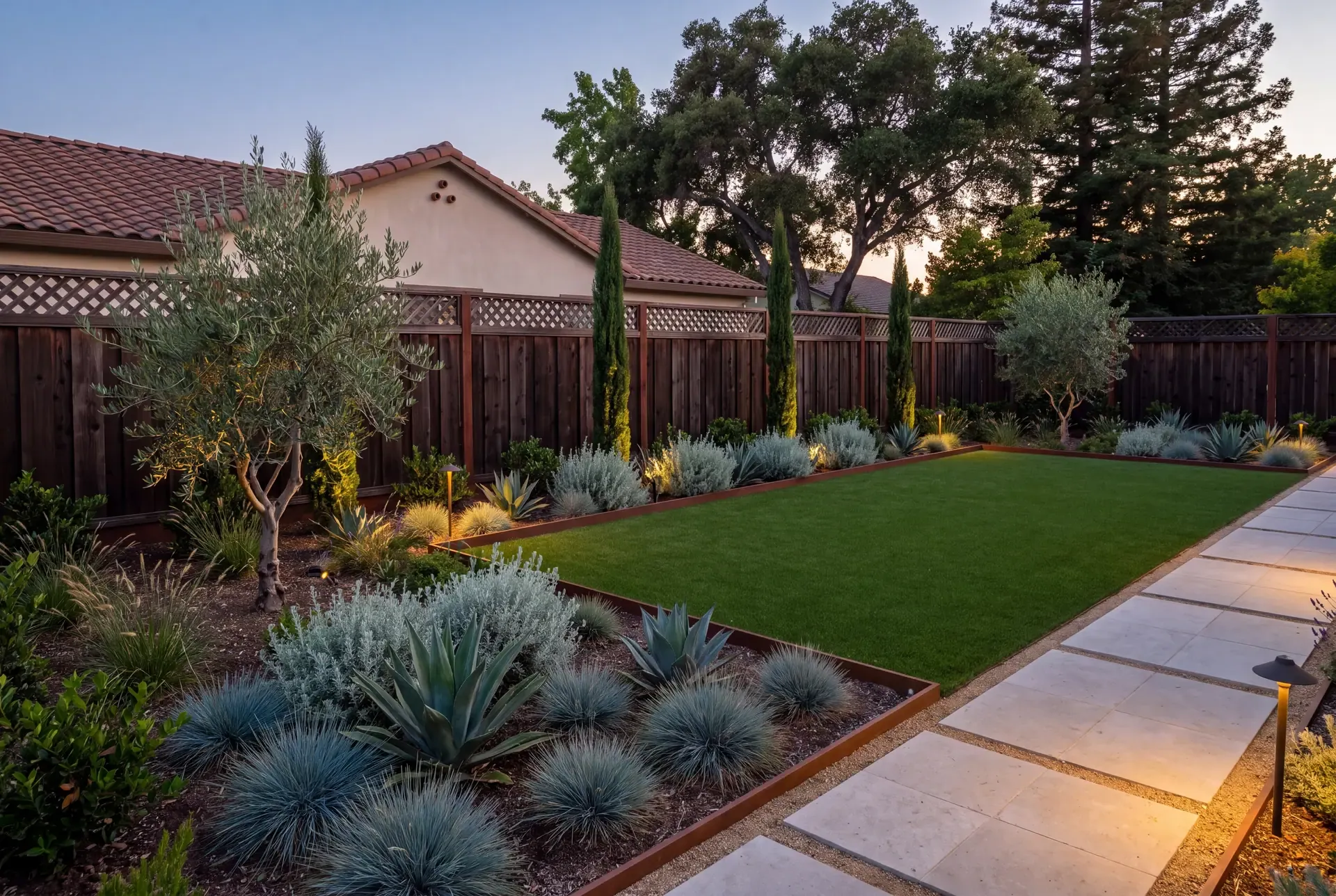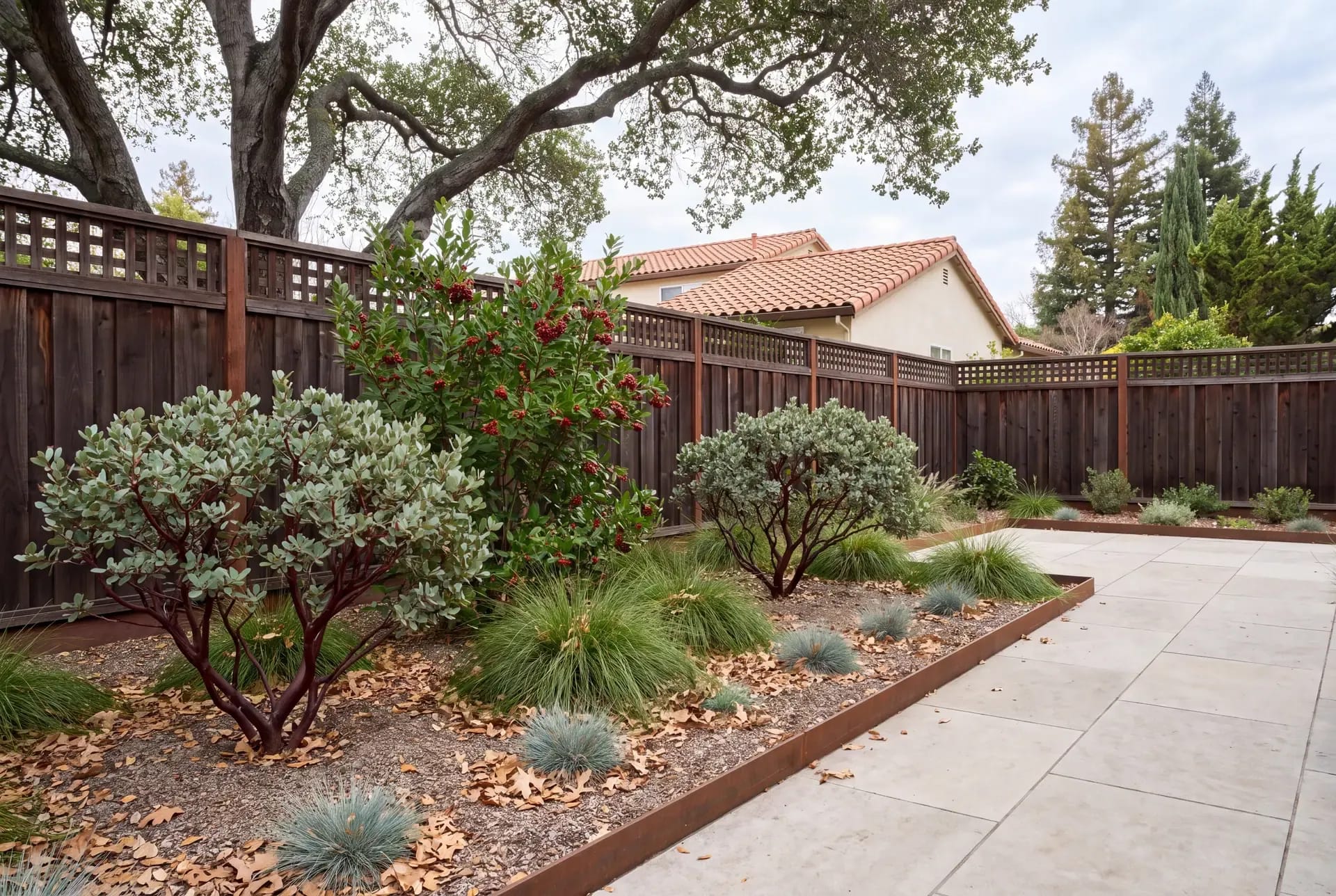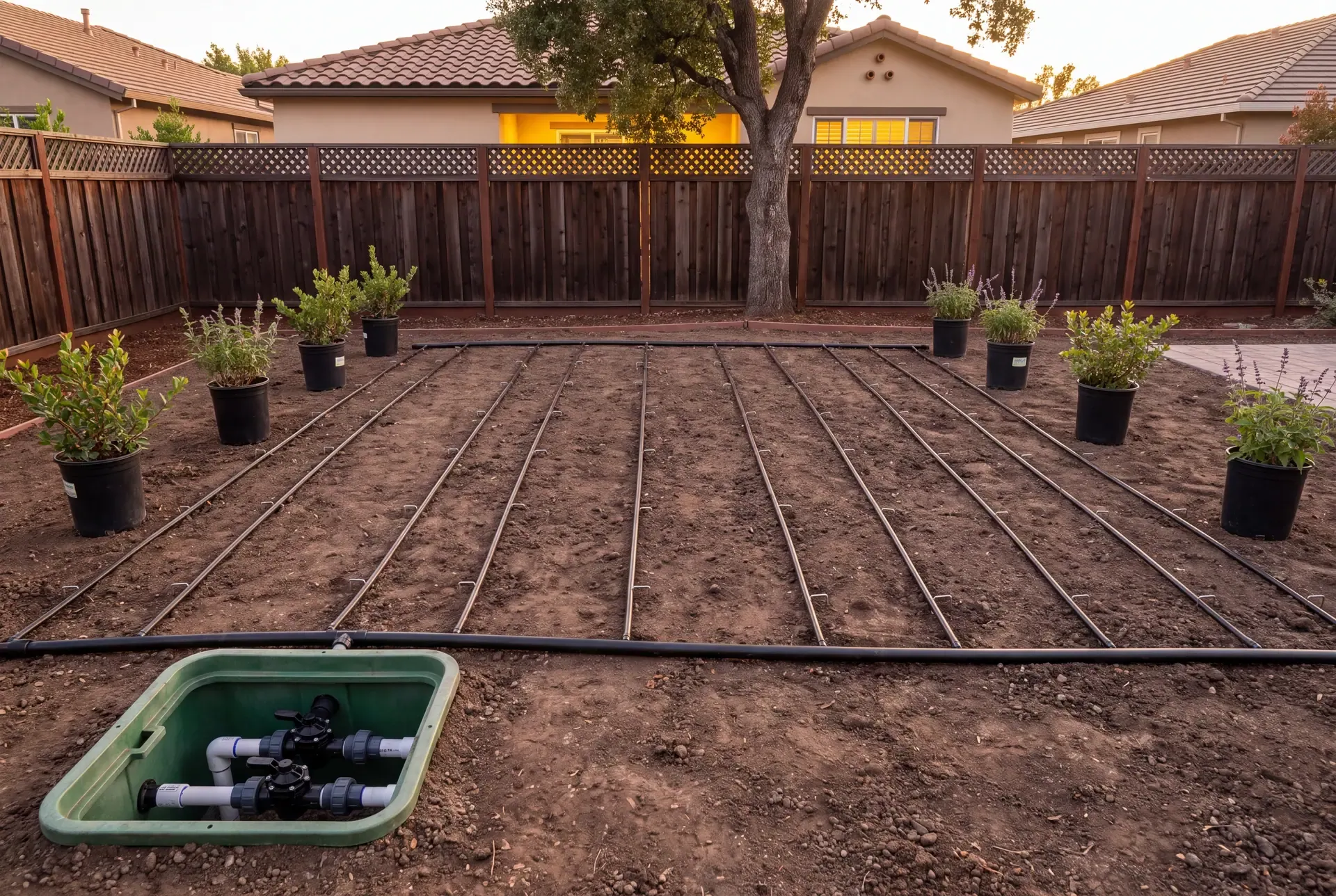
The highest-leverage upgrade most Bay Area yards can get: replace the spray heads in planting beds with drip irrigation and put it on a weather-based or soil-moisture controller. Together those changes cut outdoor water use more than almost anything short of removing lawn, they are frequently rebate-eligible, and they are increasingly what California's landscape code expects on permitted projects.
Why spray heads on planting beds are the wrong tool
Spray irrigation was designed for one crop: a dense, uniform lawn. Everything about it, from high application rate and water thrown through the air to matched precipitation across an open area, assumes grass.
Apply that same tool to a shrub bed and the mismatches stack up. Water drifts onto paths and fences. Fine droplets evaporate before they land, which matters on a hot inland afternoon. Leaves stay wet, which invites disease on plants that evolved for dry foliage. Wide spacing between shrubs means half the spray lands on bare mulch and runs off. And the system delivers the same volume to a coast live oak that wants one deep monthly soak and to a vegetable bed that wants frequent shallow water.
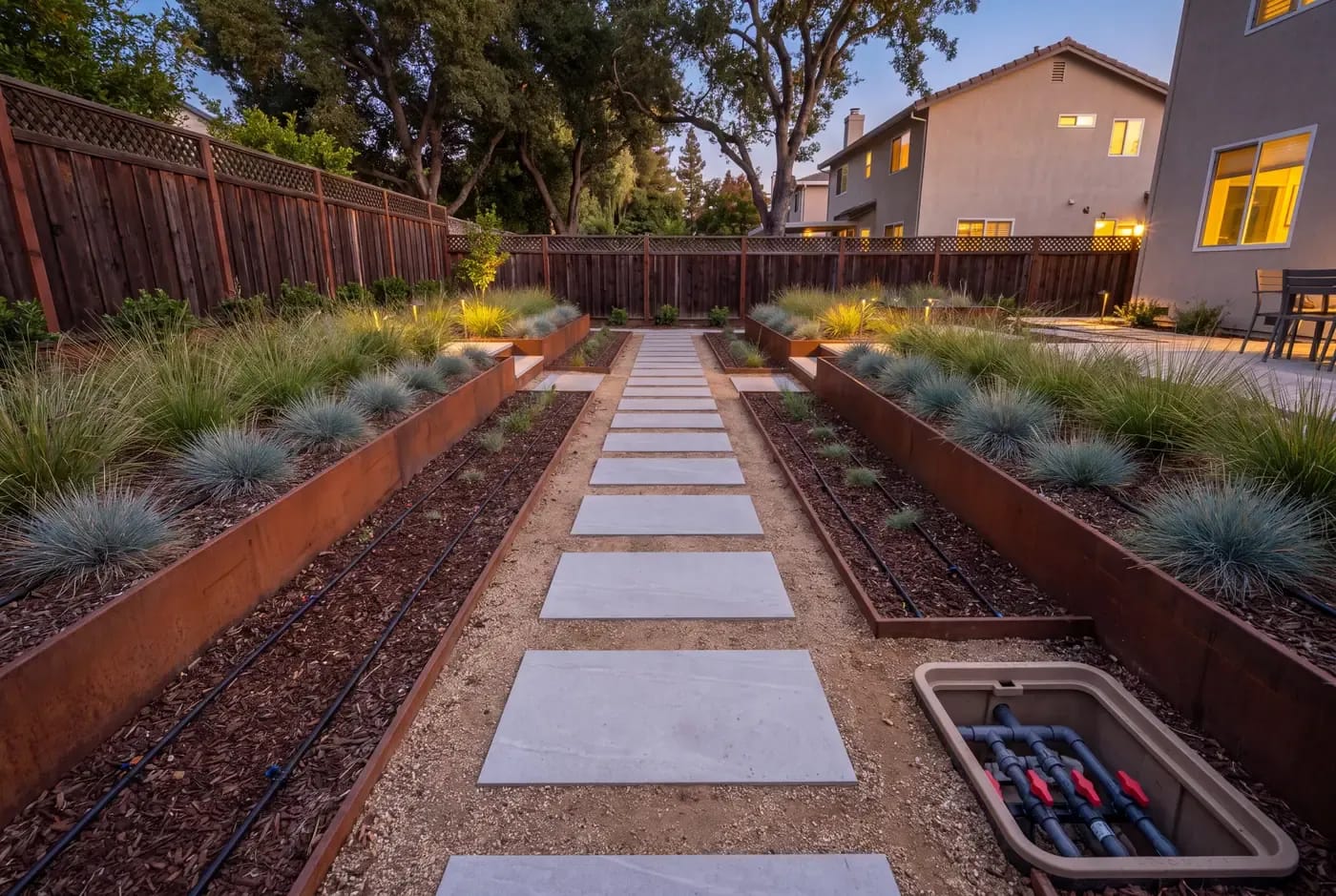
Drip irrigation applies water slowly, at ground level, directly to each plant's root zone. Low volume means low runoff, low evaporation, and the ability to give every plant exactly what it needs and nothing it does not.
Converting a spray zone to drip: what the work actually involves
There are two main flavors, and the right one depends on the planting.
- Inline drip tubing has factory emitters built in at regular spacing, typically twelve or eighteen inches apart. It is the right tool for dense beds, hedgerows, groundcovers, and lawn conversions, where you want even coverage across an area.
- Point-source emitters are individual emitters punched into blank tubing and sized per plant, such as a two-gallon-per-hour emitter at each shrub or a ring of emitters around a tree. They fit spaced specimen plantings where each plant gets its own delivery.
A typical conversion reuses the existing valve and lateral lines:
- Cap or remove the spray heads and stub off the risers.
- Connect drip tubing to the lateral lines at the head locations.
- Install a pressure regulator. Spray systems run around thirty pounds per square inch; drip fittings are comfortable well below that, and excess pressure blows emitters off tubing. This step is not optional.
- Install a filter. Drip emitters have tiny passages and municipal water carries particulate. Clogging is the number-one drip maintenance complaint, and a disc filter at the head of the zone prevents most of it.
- Check the flow range. Drip zones flow far less than spray zones, so confirm the valve operates cleanly at the new, lower flow, and adjust or resize if a zone gets too small.
If the bed is an established garden, convert zone by zone and run old and new schedules in parallel for a season. Plants raised on spray have shallow, widespread roots and can stress if delivery changes overnight.
Hydrozoning: one valve, one water need
Hydrozoning means grouping plants with similar water needs, along with similar sun, slope, and soil conditions, on their own valve. It is the organizational rule that makes everything else in this article work, because a controller can only be as precise as the zones it commands.
In practice, a South Bay yard ends up with zones like these: drought-adapted natives and Mediterranean shrubs on one valve; a rose or vegetable bed on another; any remaining lawn on its own; young trees on a separate line so they can be watered deeply and infrequently without drowning the shrubs around them. California's landscape code, covered in our MWELO explainer, puts this in writing for permitted projects: each valve must irrigate a hydrozone with similar conditions, and trees should sit on their own valves where feasible.
The native-planting connection is direct. You cannot taper natives off summer water, which is how they are meant to be grown, if they share a valve with thirsty plants. The watering rule in our native plants guide starts at the valve box, not at the hose bib.
Smart controllers: weather-based and soil-moisture options
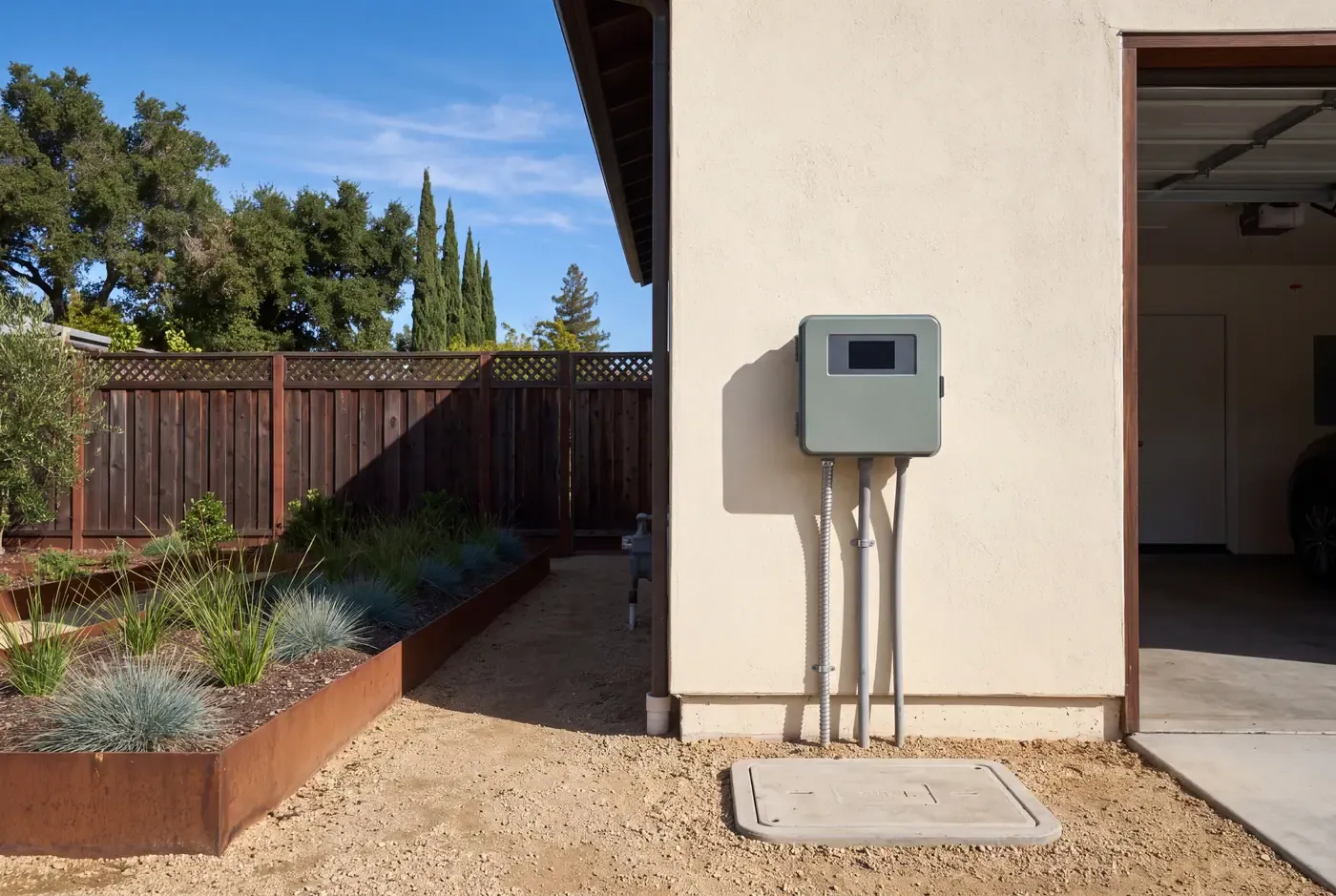
A fixed timer waters the same schedule in March as in August. A smart controller adjusts the schedule to conditions, and the EPA's WaterSense program labels two kinds:
- Weather-based controllers, also called ET controllers, use local weather data and evapotranspiration estimates (how much water the atmosphere is pulling out of the landscape) to lengthen or shorten run times. WaterSense-certified models are tested against the industry standard, ANSI/ASABE S627, for accuracy and performance.
- Soil-moisture sensor controllers measure water content at the root zone and block scheduled cycles when the soil is already wet enough. They shine in microclimate-heavy Bay Area yards where weather data misses the fog line or the wind shadow.
Either type is a large upgrade over a clock timer, and both are common rebate targets. Pair the controller with a rain sensor that suspends irrigation during storms, which used to be good practice and is now code language on qualifying projects, and program it against real plant needs rather than factory defaults. The hardware only helps if someone sets it once, correctly, and lets it work.
Master valves and flow sensors: leak protection that works while you are away
The nightmare scenario in any irrigation system is a break you do not see: a line split by a shovel, a valve stuck open, a head sheared off by a trimmer. Without protection, that break runs at full flow until someone notices the bill, or the neighbor calls.
- A master valve sits at the point of connection and only opens when a zone is running. No zone, no water in the lateral lines. A break between the master valve and the zone valves still leaks, but the far more common failures downstream of a zone valve are contained.
- A flow sensor measures what the system actually uses and shuts the system down, or sends an alert, when flow looks wrong — a zone drawing more than its design, or flow at two in the morning when nothing should be running.
California's model ordinance requires flow sensors on all non-residential landscapes and on residential landscapes over five thousand square feet, and a master shutoff on nearly everything. Even where it is not required, this is cheap insurance for a system running behind a screen of shrubs.
Slopes, check valves, and pressure-compensating emitters
Hillside yards in Los Gatos and the Peninsula foothills add two physics problems. Water pressure climbs at the bottom of a slope and drops at the top, so emitters at the low end overwater while the top dries out. And when a zone shuts off, water in the lateral lines drains to the lowest head and puddles.
The fixes are standard hardware:
- Pressure-compensating emitters deliver the same flow across a range of inlet pressures, so the top of the slope and the bottom get the same dose.
- Check valves, or anti-drain valves, hold water in the line when the zone shuts off, ending low-head drainage and the muddy patch that comes with it.
- Cycle-and-soak scheduling runs short repeated cycles so clay soil can absorb each dose instead of shedding it. The model ordinance caps application rates on slopes steeper than twenty-five percent for exactly this reason.
Mulch, seasons, and tapering natives off summer water
Mulch is part of the irrigation system, not a cosmetic. Three inches of mulch over a drip zone cuts evaporation, moderates soil temperature, and keeps emitters from drying out the surface into dust. The code agrees: on permitted projects, low-volume irrigation is required in mulched planting areas, and overhead spray is prohibited within two feet of any non-permeable surface.
Seasonally, the Bay Area rhythm looks like this:
- Winter. Most systems can run little or not at all in December and January. Let the rain sensor do its job.
- Spring. A short audit: walk each zone, check for clogged emitters and broken heads, adjust the controller's seasonal percentage as temperatures rise.
- Summer. Deep, infrequent runs for trees and shrubs; frequent shallow runs only for edibles and establishment plantings.
- Fall. Taper everything down as the first rains arrive, and shut down or minimize zones serving established natives.
That fall taper is where native plantings pay off. A yard of climate-appropriate plants on well-designed drip can approach zero summer irrigation after establishment, and the controller simply follows the plants down.
Rebates, code, and getting it installed
Controller upgrades and drip conversion are, as of 2026, among the most commonly rebated irrigation upgrades in the region. Valley Water runs separate incentives for in-line drip conversion and for irrigation equipment upgrades, including weather-based controllers and rain sensors. BAWSCA's smart controller rebate serves participating Peninsula agencies, and EBMUD rebates efficient irrigation equipment for East Bay customers. Rates and funding change, so confirm current terms with your own agency before buying equipment — the same caution applies to the turf replacement programs in our rebate guide.
If your irrigation upgrade rides along with a permitted landscape project, the equipment list stops being a suggestion: California's model landscape ordinance can require ET or soil-moisture controllers, pressure regulation, master valves, flow sensors, and dedicated irrigation meters depending on project size. R&R Backyard Remodeling builds irrigation into its landscape work from the valve box out, so the zones, the hardware, and the documentation line up on the first pass. If you want a system that waters by plant need and shuts itself off when something breaks, a consultation is the place to start.