California's 2026 legislative session brought four significant ADU bills into law, all effective January 1, 2026: SB 543, AB 1154, AB 462, and clarifications to SB 9. Together they expand what Bay Area homeowners can build, cut fees across the board, and close gaps that cities had used to slow approvals. If you are planning a backyard unit in San Jose, Palo Alto, Los Gatos, or anywhere on the Peninsula, these changes directly affect your project.
What Changed on January 1, 2026
The headline changes fall into four areas: fee reform, JADU ownership rules, permit timelines, and unit-count clarification. Several of these build on California's already permissive ADU framework — one that has been layered in over multiple legislative sessions starting with the landmark 2019–2020 bills — but the 2026 package addresses specific gaps that had frustrated homeowners and builders.
SB 543: Fee Reform and JADU Cleanup
SB 543 is the largest of the four new bills. It rewrites several definitions and fee provisions for both ADUs and JADUs.
Impact fees are now barred for ADUs up to 750 square feet of interior livable space. Above that threshold, any impact fee must be charged proportionately — calculated relative to the square footage of the primary dwelling, not as a flat rate for the new unit. This replaces a patchwork where some cities charged ADU impact fees as though the unit were a full second home. For JADUs, impact fees are barred entirely for units up to 500 square feet of interior livable space.
School district development fees do not apply to ADUs or JADUs under 500 square feet. For many homeowners, school fees were one of the larger line items in a permit package. Removing them for smaller units materially changes project feasibility.
The bill also clarified that a local agency must ministerially approve a building permit application for one detached ADU, one interior-conversion ADU, and one JADU on the same single-family lot — up to three additional units total, provided each meets its statutory standards. This had been the subject of some local-agency foot-dragging; SB 543 makes the combination explicitly a ministerial approval, removing discretionary hearing requirements.
On the technical side, SB 543 amended the JADU definition to reference "interior livable space" rather than total square footage, aligning it with how other housing statutes measure unit size.
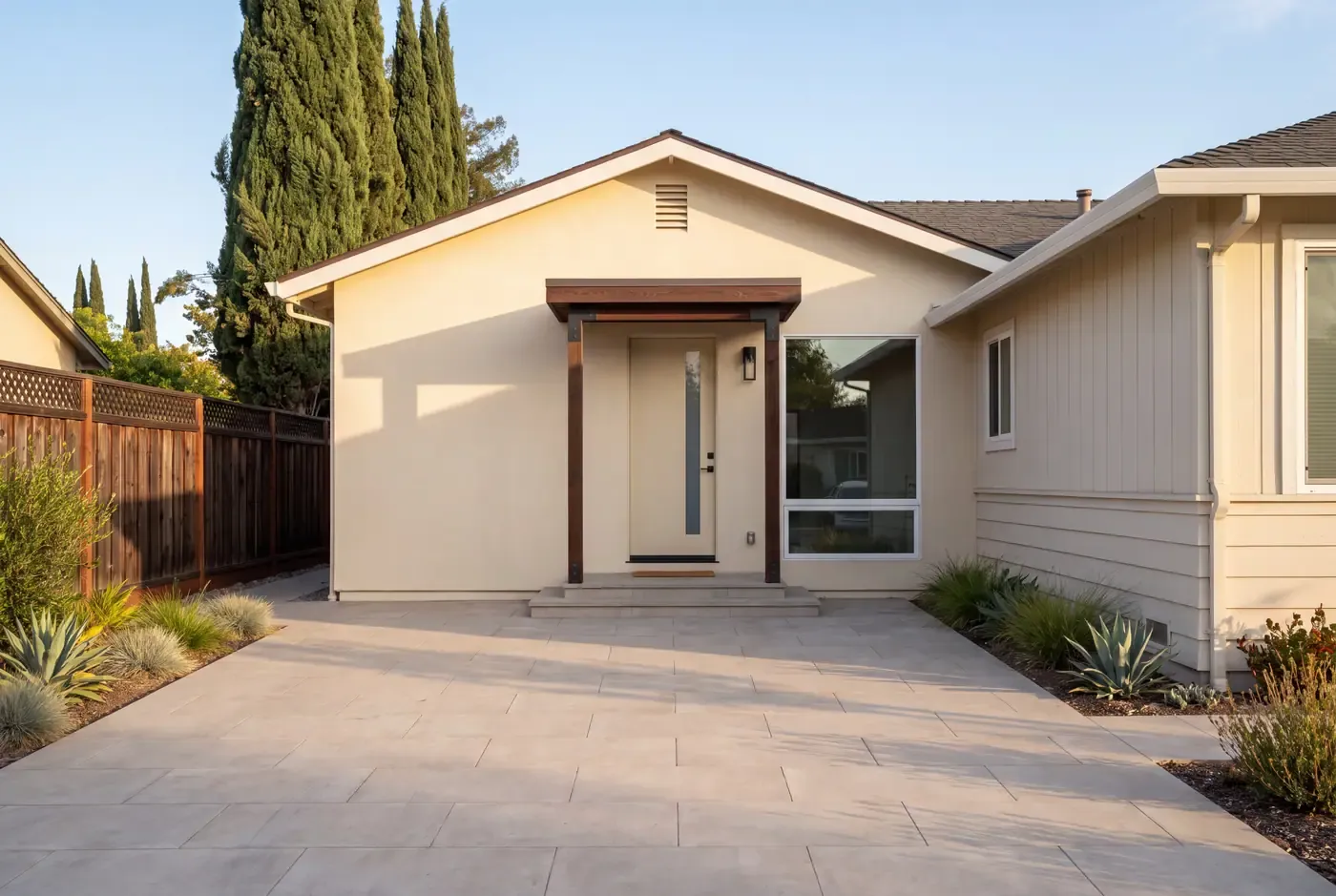
AB 1154: JADU Owner-Occupancy — Independent Sanitation Changes the Rule
AB 1154 made one focused but consequential change to JADU law. Previously, all JADUs carried a requirement that the property owner live in either the primary residence or the JADU itself. Under the new law, that owner-occupancy requirement applies only if the JADU shares sanitation facilities (bathroom) with the primary dwelling.
If your JADU has its own bathroom — even if it is still within the walls of the main house — owner-occupancy does not apply. This distinction is meaningful for Bay Area homeowners who want to create a genuinely independent rental unit within their existing footprint. A converted den with its own full bath now qualifies, without tying the owner to the property.
The bill also codified that JADU rentals must be for terms longer than 30 days, closing a loophole that had allowed short-term rental use.
AB 462: Emergency Housing and the Coastal Permit Clock
AB 462 addresses two situations. First, it allows a local agency to issue a certificate of occupancy for an ADU even when the primary dwelling has not yet received its certificate — but only when the primary dwelling was substantially damaged or destroyed in a governor-declared state of emergency on or after February 1, 2025. This is directly relevant to fire-affected areas in the Santa Cruz Mountains foothills, where homeowners rebuilding after wildfire can now occupy an ADU on the property while the main house is still under construction.
Second, the bill extends the 60-day deemed-approved clock to coastal development permits processed by the California Coastal Commission. Previously, coastal-zone ADU applications could face separate, un-timed review. Now the Coastal Commission must act within 60 days of receiving a completed application — the same standard that applies to local agencies — and if it does not, the application is deemed approved.
SB 9 Clarifications
SB 9, the 2021 law allowing lot splits and duplexes on single-family parcels, received technical clarifications in the 2026 session. The updates do not change the core SB 9 framework but resolve ambiguities around how SB 9 lot splits interact with ADU and JADU placement on the resulting parcels. The practical takeaway: a homeowner who splits a lot under SB 9 can still build ADUs on each resulting parcel under the separate ADU statute, and the 2026 language makes that clearer.
The Standing ADU Framework — What Was Already True
To understand what the 2026 bills changed, it helps to know what the baseline already was. California's ADU laws, built over several sessions, establish a floor that all cities must meet — including every jurisdiction in the Bay Area.
Provision | State Minimum (as of 2026) |
|---|---|
Detached ADU max size | 1,200 sq ft (single-family lot) |
Attached ADU max size | 50% of primary dwelling, up to 1,200 sq ft |
Side and rear setbacks | 4 feet for new detached ADUs |
Height limit | 16 feet (18 ft if within 1/2 mile of transit) |
Front setback | Follows underlying zone |
Parking requirements | None if within 1/2 mile of transit; one space otherwise |
Owner-occupancy (standard ADU) | Not required |
JADU max size | 500 sq ft interior livable space |
JADU owner-occupancy | Required only if shared sanitation (as of 2026) |
Permit clock | 60 days, deemed approved if not acted upon |
These are state minimums. A city may adopt more permissive rules — several Bay Area jurisdictions have — but cannot be more restrictive than this floor.
What This Means for Bay Area Homeowners
The 2026 package is particularly relevant to the South Bay and Peninsula for a few reasons.
Fee savings are most pronounced in high-cost jurisdictions. Cities like Palo Alto, Menlo Park and Los Altos have historically attached substantial impact fees to residential construction. Under SB 543, an ADU up to 750 square feet in those cities cannot be charged impact fees, and a JADU up to 500 square feet is similarly exempt. This shifts the financial calculation meaningfully — though you should still confirm with each city's building department, as fee structures vary and water/sewer connection charges have their own rules.
The coastal permit change matters for Half Moon Bay, Santa Cruz, and other coastal-zone properties. If your property falls within the coastal zone boundary, the ADU permit process now has the same 60-day clock as inland projects, reducing a timeline that could previously run six months or longer.
The JADU ownership change opens more flexibility on the Peninsula. Many older Peninsula homes — particularly the Eichler-era houses common in Palo Alto, Sunnyvale and San Mateo — have attached garages or den spaces that can accommodate a 500-square-foot JADU. Under AB 1154, if you can include a separate bathroom in that conversion, you do not need to live on the property.
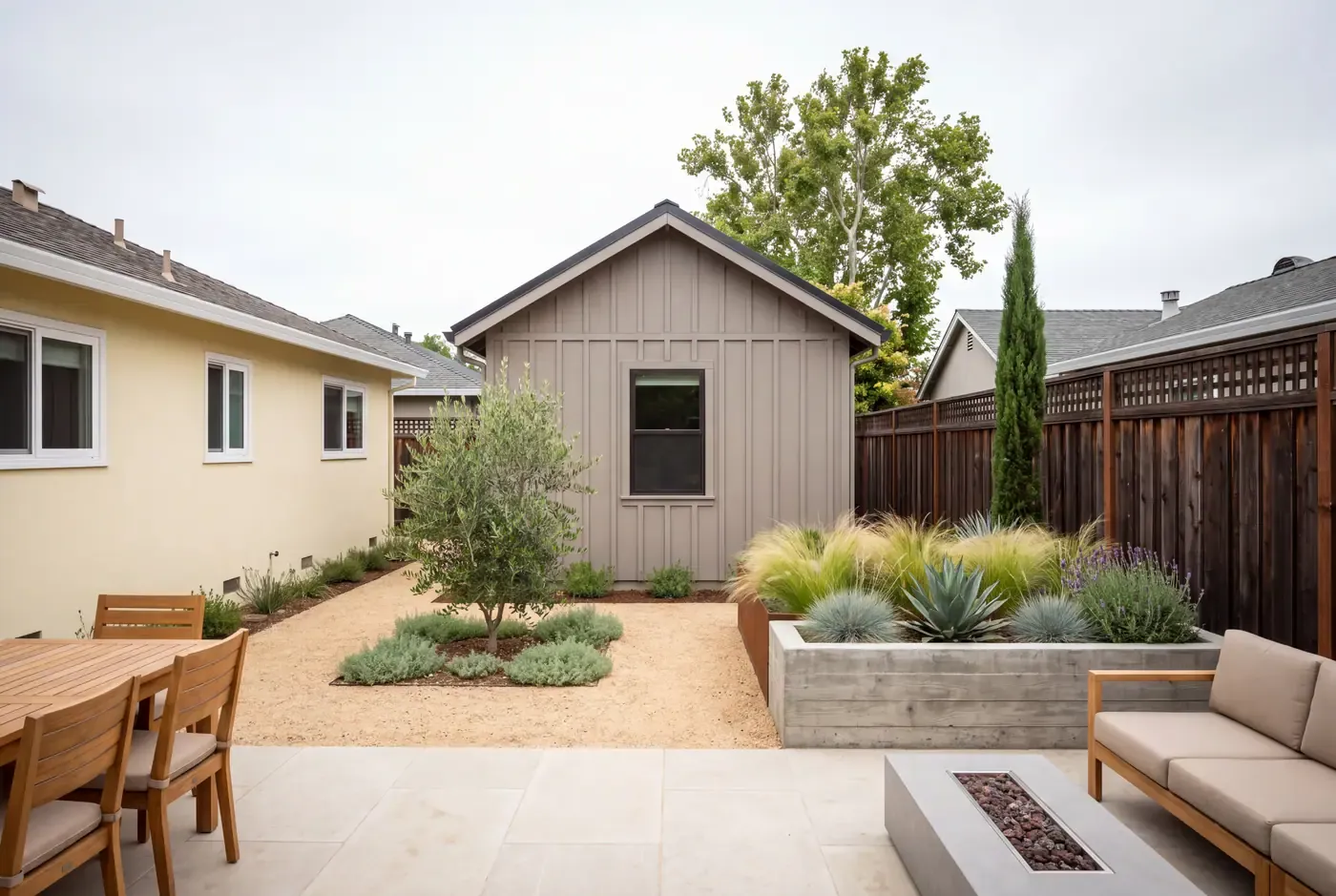
How R&R Handles ADU Permits
ADU permitting in the Bay Area involves navigating state law, local ordinances, and sometimes HOA covenants — often with different interpretations from one city hall to the next. R&R Backyard Remodeling handles all permitting in-house as part of our ADU and pool house service. Our designers, who are also your project managers, prepare the architectural plans, site plan, Title 24 energy compliance documentation, and all submittal packages, then manage the review process with the city until permits are issued. You never visit a planning counter.
We also handle the coordination piece that the statute does not cover: scheduling. A permit approval on paper still requires scheduling inspections, coordinating utility connections, and sequencing trades — and that is where our design-build process keeps the project on track.
For a deeper look at how ADU types compare, read our breakdown of detached ADUs versus garage conversions versus JADUs.
What to Watch
ADU law in California continues to evolve. The California Department of Housing and Community Development (HCD) maintains the official ADU handbook and guidance. That is the most reliable single source for current state-level requirements — check it, and your own city's ADU page, before you rely on any figure in this article.
At the local level, some Bay Area cities adopt their own ADU ordinances that go beyond the state floor. San Jose's ADU program, for example, includes pre-approved plan sets. Always check with your city's planning or building department for the latest local rules — a conversation that R&R handles as part of our permitting service.
If you are considering an ADU on your Bay Area property, contact us for a consultation. We will walk you through what is possible on your specific lot, what the current rules allow, and what the design and build process looks like from start to finish.