Two rules drive residential pool safety in California: the state's Swimming Pool Safety Act (Health and Safety Code §§ 115920-115929) and the federal Virginia Graeme Baker Pool and Spa Safety Act. The state law sets the safety features your pool or spa must have at build or remodel; the federal law governs drain covers.
This article is an overview, not legal advice. Specific situations turn on your jurisdiction, the date your permit is filed, and the inspector who reviews the work. The right answer for your project is the one your building department tells you in writing.
The California Swimming Pool Safety Act at a glance
The Swimming Pool Safety Act is a California state law, found at Health and Safety Code Sections 115920 through 115929, originally added to the codes in 1996 and amended several times since. Its core requirement, in Section 115922, applies when a building permit is issued for the construction of a new swimming pool or spa, or for remodeling work on an existing pool or spa, at a private single-family home. When that trigger is met, the pool or spa must be equipped with at least two of the seven drowning-prevention safety features listed in the law.
The most recent amendments came in 2024 through SB 552, which took effect January 1, 2025, and tightened several definitions, including the requirement that any alarm be in good repair and operable as designed, and the requirement that the "other means of protection" alternative meet standards from a nationally recognized standards organization. The 2024 update also clarified that certain combinations of features do not satisfy the two-of-seven requirement.
The law does not apply to public swimming pools, to apartment complexes, or to any residential setting other than a single-family home. Spas and hot tubs with a locking safety cover that meets ASTM F1346 are also exempt.
The seven approved drowning-prevention safety features
Section 115922(a) lays out the seven features, in order. The list reads as follows:
- An enclosure that meets the requirements of Section 115923 and isolates the swimming pool or spa from the home.
- Removable mesh fencing that meets ASTM F2286, paired with a gate that is self-closing and self-latching and that can accommodate a key-lockable device.
- A manually operated or power-operated safety pool cover that meets ASTM F1346-23 specifications, accompanied by an applicable label.
- Exit alarms on the home's doors and windows that provide direct access to the pool or spa, sounding when the door or window is opened or left ajar.
- A self-closing, self-latching device with a release mechanism placed no lower than 54 inches above the floor on the home's doors providing direct access to the pool or spa.
- A pool or spa alarm in good repair and operable as designed, certified to ASTM F2208, which detects accidental or unauthorized entry into the water. A child-worn alarm does not qualify.
- Other means of protection with equivalent or greater protection, independently verified by an approved testing laboratory as meeting standards established by ASTM International, the American Society of Mechanical Engineers, or another nationally recognized standards development organization, accompanied by a label that verifies compliance.
Any two of these features satisfy the law's basic requirement at plan check. The law was drafted deliberately to allow flexibility, because no single feature is foolproof and a layered approach is the only approach that meaningfully reduces risk to young children.
Combinations that do not satisfy the requirement
SB 552 added Section 115922(b), which lists combinations that do not satisfy the two-of-seven requirement. These combinations were seen as providing a false sense of safety because the two features share a single point of failure:
- An exit alarm and a self-closing, self-latching device on the same door
- An exit alarm and a door latch on separate doors
- A safety pool cover and a pool alarm under feature (6)
Choosing a pool alarm and a door alarm on the same door does not meet the law, even though both are listed in the seven features. The right combinations are the ones that attack the problem from two different angles.
Enclosure specifications if you choose a fence
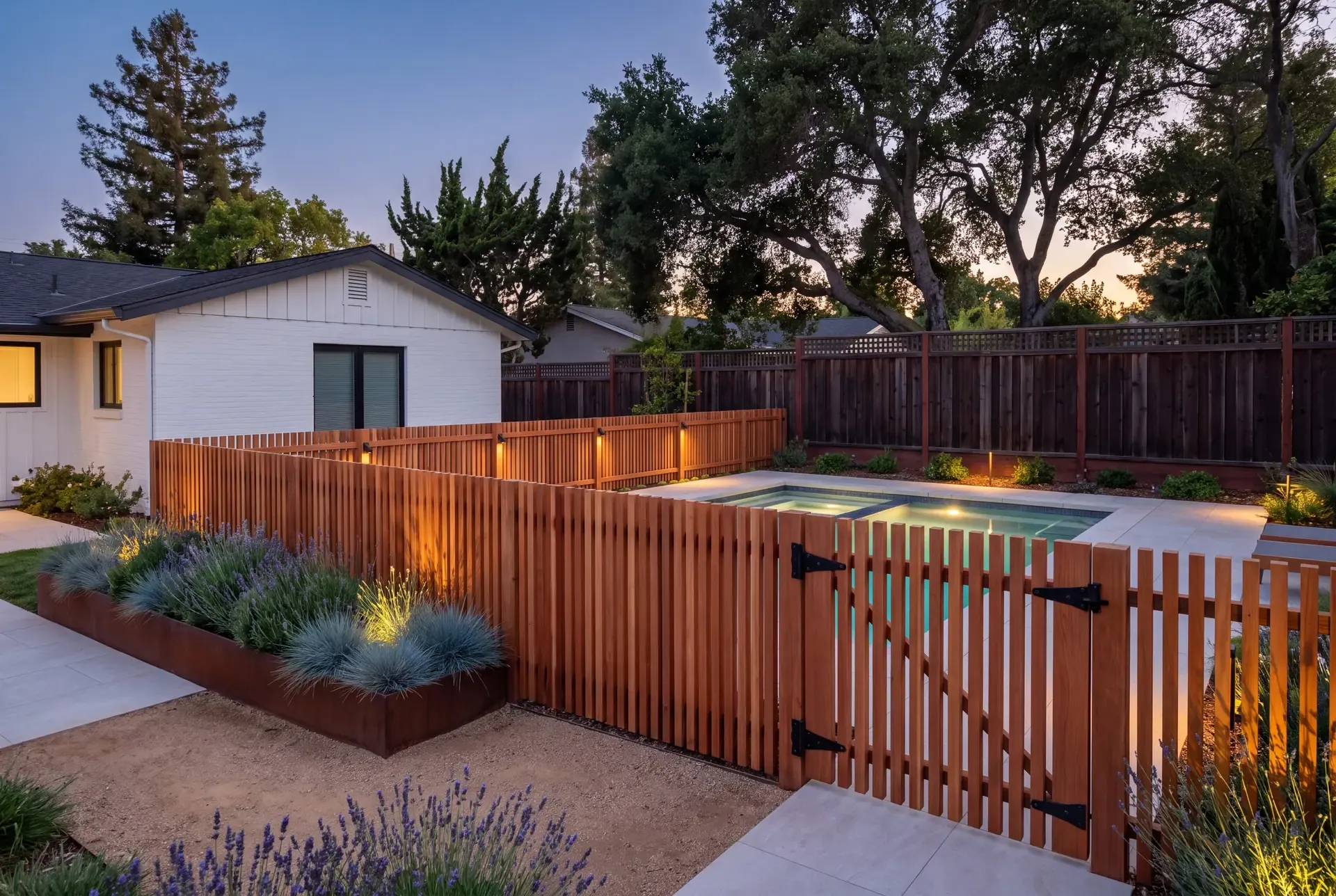
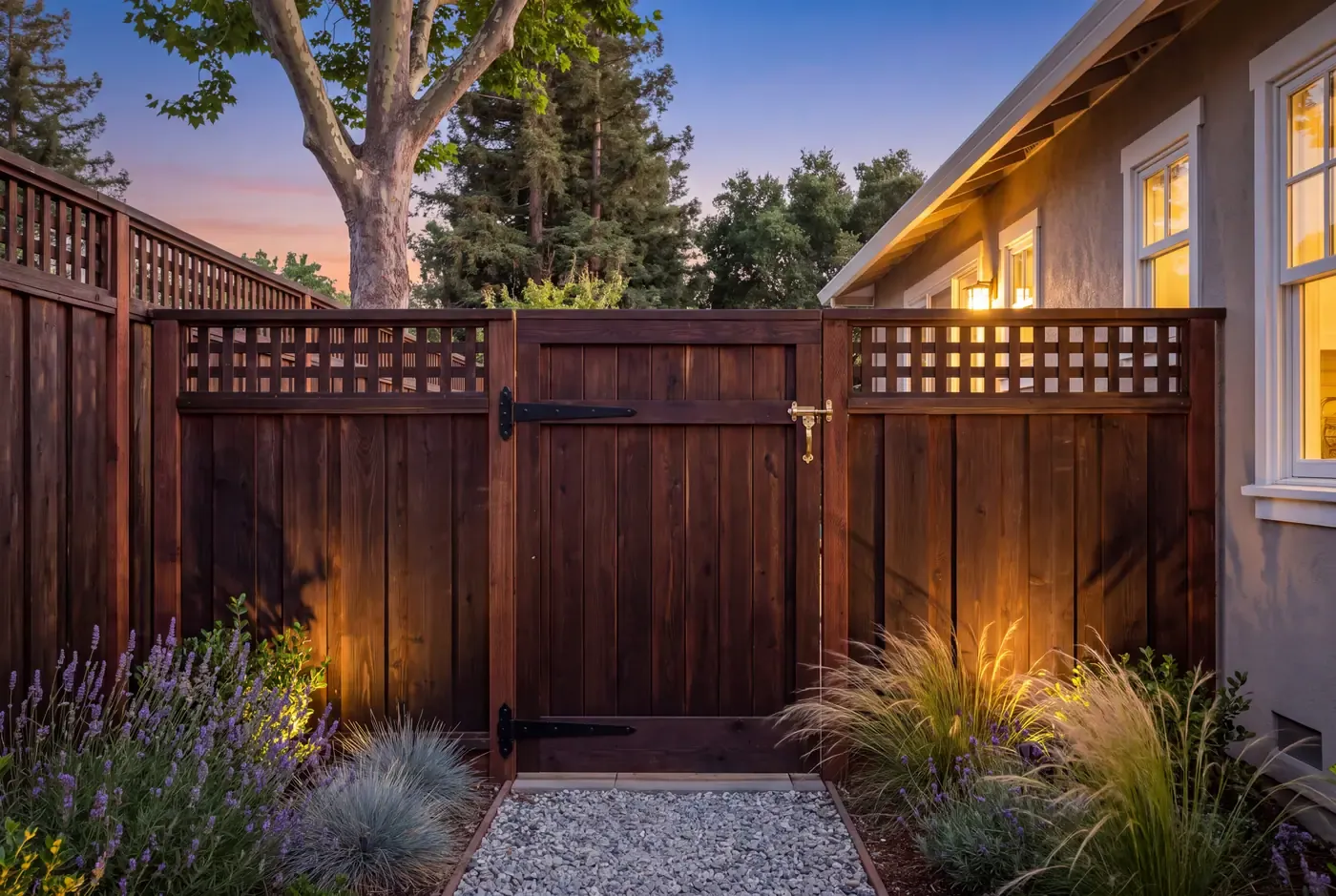
If the enclosure (feature 1) is one of your two choices, Section 115923 lays out the specifications. An enclosure must:
- Have any access gates opening away from the pool, with a self-closing device and a self-latching device no lower than 60 inches above the ground
- Have a minimum height of 60 inches
- Have a maximum vertical clearance from the ground to the bottom of the enclosure of 2 inches
- Have gaps or voids that do not allow passage of a sphere 4 inches or larger
- Have an outside surface free of protrusions, cavities, or other features that would serve as handholds or footholds for a child under five
These specifications describe a specific kind of fence. A standard 6-foot wood or wrought-iron fence built with the right hardware and bottom clearance typically complies. Chain-link with privacy slats, masonry walls, and some glass panel systems can also comply when installed to the listed dimensions.
The American Academy of Pediatrics, in its 2019 policy statement on drowning prevention, identified a pool isolation fence as the most studied and effective single feature. That is also the feature that California's home inspection disclosure law now requires inspectors to mention by name.
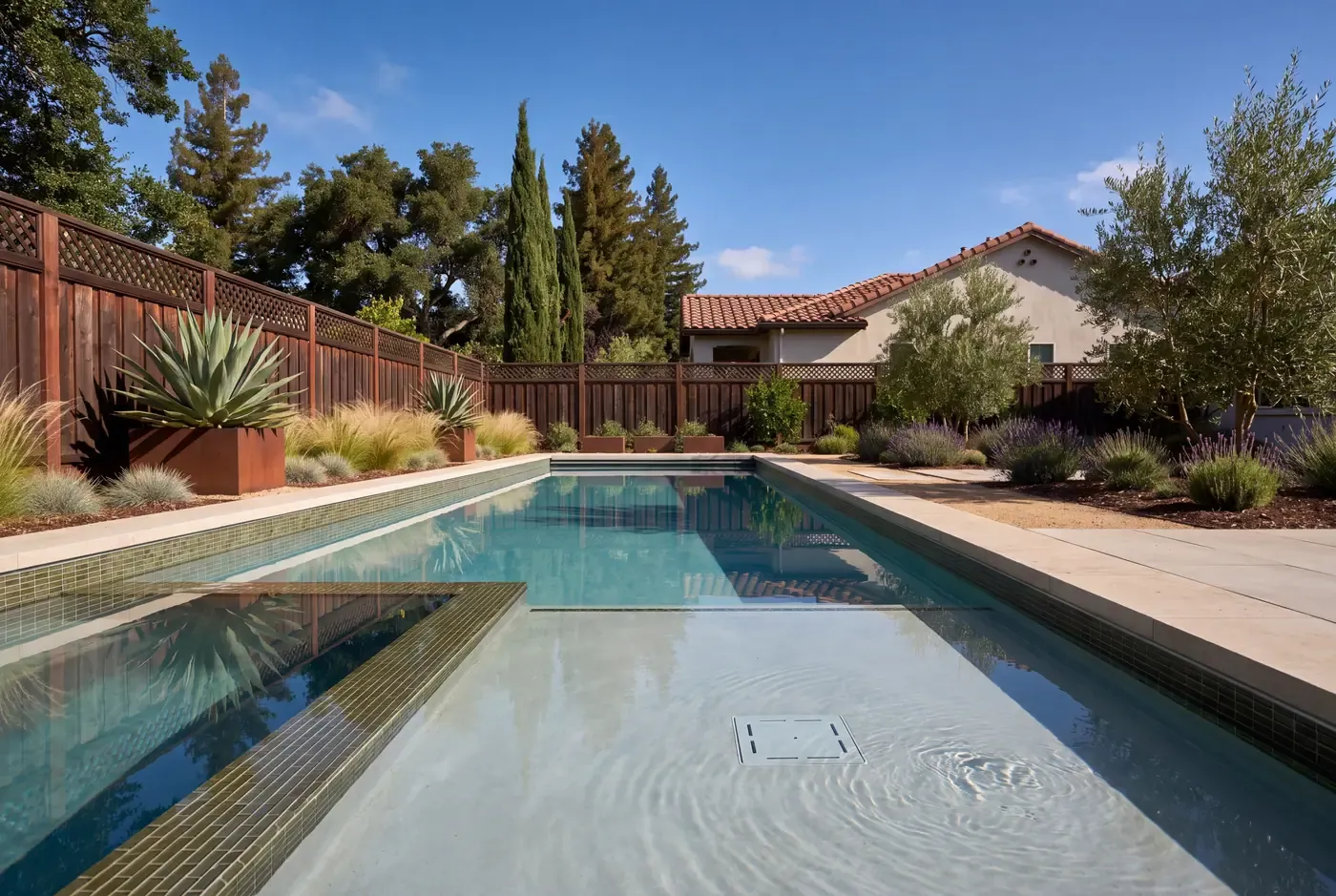
The federal side: Virginia Graeme Baker and drain covers
The Virginia Graeme Baker Pool and Spa Safety Act was signed into federal law in December 2007, codified at 15 U.S.C. § 8001 and following, in response to entrapment injuries and fatalities in pool drains. The Act's most practical effect on a residential project is the drain cover rule: any pool or spa drain cover replaced or newly installed after December 19, 2008 must comply with the ASME/ANSI A112.19.8 standard for drain covers, and must be correctly rated for the flow rate of the system.
Most modern residential pools and spas already have compliant covers. The rule shows up in practice during equipment replacement, when a builder must confirm that the new cover is rated for the pump's flow rate, and during drain retrofits. A simple in-floor cleaning system or a dedicated suction line installed with the wrong cover is the most common violation we see.
The federal Act also recognizes additional layers of protection beyond drain covers, including safety vacuum release systems (SVRS), which are devices that automatically vent a blocked drain to release suction. SVRS systems are tested under ANSI/PSPS/ICC-7-2013 or ASTM F2387 and are an option when the equipment configuration makes a single anti-entrapment cover alone inadequate.
Permits, inspections, and who enforces what
Building permits trigger safety review. California state law reaches the residential pool through the building permit, not through any self-imposed homeowner checklist. When a permit is pulled for a new pool or spa, or for a remodel, the plans must identify which two of the seven features are being installed, and the building official must inspect those features before issuing final approval.
Inspections typically happen at two points. The enclosure, alarm, and any gate hardware are inspected before final approval is granted. Drain covers and suction outlet configurations are reviewed when the equipment is installed. If either inspection is missed, the permit cannot be closed out and the property record shows an open permit, which becomes a problem at sale.
Local jurisdictions add their own layer. Many cities adopt ordinances that exceed state law. San Jose, Santa Clara, Sunnyvale, and other South Bay cities have specific setback, gate, alarm, and equipment rules that supplement the state framework. Some require specific certifications or additional layers of protection for outdoor pools in densely built neighborhoods. For any specific project, the local building department is the right authority.
For homeowners working through a small-lot pool or spa design, the right safety plan often sits inside a larger conversation about pool shape and patio layout; our small-lot pool design guide shows how the barrier plan and the pool shape get drawn together. Where the deck meets the safety conversation, hardscape selection ties into both — surfaces that support drainage and slip resistance pair cleanly with the enclosure requirements.
A few things this article is not
A pool safety article on a contractor's website has limits, and it is worth naming them. This article is not a substitute for the actual statutory text, which can be read at the California Legislative Information site for Health and Safety Code Section 115920 et seq.. It is not a substitute for current local amendments; the City of San Jose, for example, has its own pool safety ordinance layer that an attorney or your building department can walk you through. And it is not a substitute for the kind of risk conversation every household should have with their own children, guests, and caregivers.
For homeowners planning a pool or spa project, the most useful takeaway is also the simplest: design and build the two layers of protection the code asks for, treat the code's listed standards (ASTM F1346, F2208, F2286; ASME/ANSI A112.19.8) as non-negotiable specifications, and get your local building department to sign off on the final configuration before the project is closed out.
R&R Backyard Remodeling handles pool and spa construction and the permitting that goes with it on projects across the South Bay and Peninsula. If you are weighing a new build or remodel and want to talk through the safety and code questions, the pool and spa construction page is a good place to start.